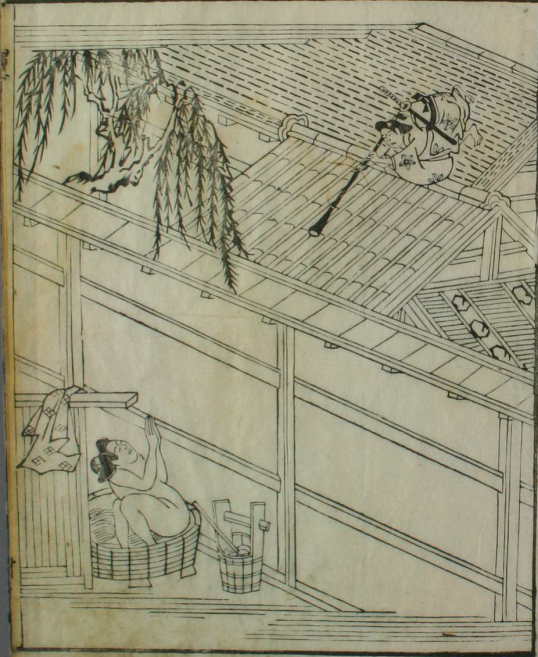
Illustration from Ihara Saikaku's "The Life of an Amorous Man"
This course will introduce three key works by Ihara Saikaku (1642–1693), widely acclaimed as early-Tokugawa Japan’s greatest writer of fiction. The first lecture will outline the historical and cultural context of Saikaku’s stories and novels: the status-group system imposed by the Tokugawa regime; the rapid growth of cities in 17th-century Japan, the expansion of a literate bourgeoisie and the concomitant emergence of a publishing industry; the licensed prostitution quarter as cultural hub; the Buddhism-derived aesthetics of evanescence; age-structured male homosexuality and normative male bisexuality; consumerism and sumptuary laws.
In our first session we will also examine Saikaku’s first published work of fiction, Kōshoku ichidai otoko (The Life of an Amorous Man, 1682), a sophisticated parody of and homage to the aristocratic courtly romances Tales of Ise (900s) and The Tale of Genji (early 1000s) whose hypersexual bourgeois protagonist devotes his life to the pursuit of erotic adventure with female and male prostitutes and some “amateurs” as well. The second lecture will focus on Saikaku’s Kōshoku gonin onna (Five Women Who Loved Love, 1686), whose bourgeois heroines arrogate to themselves the male prerogative of sexual pursuit, with, in four out of the five stories, disastrous results. The third and final meeting will focus on Ihara Saikaku’s collection of samurai vendetta tales Budō denraiki (Exemplary Tales of the Way of the Warrior, 1687), which portray, variously, samurai bravery, cowardice, heroism and abuse of power. Reflective of the fact that in Tokugawa Japan age-structured male homosexuality was considered an erotic specialty of the samurai, this collection includes stories in which samurai youths avenge the deaths of their male lovers.
David J. Gundry is Associate Professor of Japanese and Undergraduate Faculty Advisor for Japanese at the University of California, Davis, where he teaches classes on Japanese literature from the early period to the present. He earned his Ph.D. from Stanford University. He has written several books and contributed numerous articles and book chapters. Tuttle Publishing just released Ihara Saikaku’s This Scheming World: Classic Tales of Desire, Deception and Greed in Old Japan, which was revised and with a new introduction by Prof. Gundry. He is currently working on an article regarding depictions of sexuality in Ihara Saikaku’s fiction, as well as translations of Saikaku’s Budō denraiki (Exemplary Tales of the Way of the Warrior, 1687) and Honchō nijū fukō (Twenty Cases of Filial Impiety in Japan, 1686). His research interests are medieval and early-modern Japanese literature, comparative history of the novel, and Edo period popular culture.
Reading materials will be shared with registered attendees.
Class #1 Kōshoku ichidai otoko (The Life of an Amorous Man, 1682)
David Gundry
Class #2 Kōshoku gonin onna (Five Women Who Loved Love, 1686)
David Gundry
Class #3 Budō denraiki (Exemplary Tales of the Way of the Warrior, 1687)
David Gundry
Registration Policies
The Society for Asian Art’s cancellation policy requires at least one week’s advance written notice in order to receive a refund of registration fees. This excludes our Travel programs, which have separate cancellation policies, as well as any programs where a specific refund policy is stated on the event page. Your fees will be returned to you through a check in the mail. To cancel, please contact us.
For programs located within the Asian Art Museum, the museum entrance fee must be paid separately and is not included with your registration fee.
Please note that by registering for a program, you are giving consent to the SAA to be photographed or videoed as a participant.