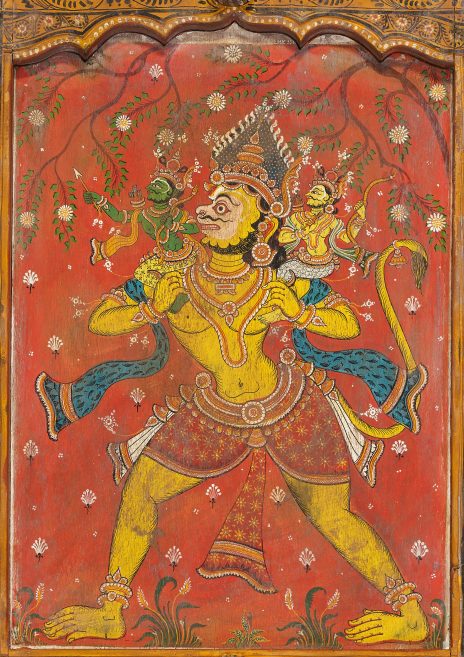
A lustful proposition accompanied by a gruesome threat. A violent, humiliating rejection. A retaliatory—and lascivious—kidnapping. A long search for the one kidnapped. A war of recovery. Slaughter. Victory. Glorification of the heroes. “Happily ever after”—or not.
Such an encapsulation bears something like the relation to the great seven-volume epic Ramayana as the AI-generated teaser “Mad prince seeks revenge, ghosts haunt, uncle dies, mother marries, tragedy” does to anther profound tale.
This two-session series also can hardly do justice to the epic of Rama, but aims to provide entry points into its vast complexity. The sessions isolate and focus on five key turning points. At each, if the characters had chosen different courses of action, everything subsequent would have changed. The characters’ choices are motivated by some combination of love, lust, jealousy, revenge, pride, strategy, and above all the sense of duty—that is, adherence to righteousness (dharma).
The five key turning points are Prince Rama’s being sent into exile as a result of machinations within the royal family, the demon king Ravana’s abduction of Rama’s wife Sita to possess her and to punish Rama for harming Ravana’s kinfolk, Rama’s allying with one rival for the kingship of the monkeys in return for help in finding Sita, Rama’s killing Ravana in battle, and Sita’s having to undergo a trial by fire when her faithfulness to Rama is questioned.
While the focus of the sessions will be on the canonical Ramayana of Valmiki, other versions, from various parts of Southeast Asia as well as South Asia, will be considered. Additional emphasis will be on representations of the key turning points in the visual and performing arts.
Participants in the sessions will be encouraged to discuss and debate the ethical and emotional dilemmas the primary characters face.
Forrest McGill is the Asian Art Museum’s Emeritus Senior Curator of South and Southeast Asian Art. For more than 20 years, he organized major exhibitions such as The Rama Epic: Hero, Heroine, Ally, Foe and Beyond Bollywood: 2,000 Years of Dance in the Arts of South Asia, Southeast Asia and the Himalayan Region. He has edited and co-edited numerous exhibition related catalogs in addition to giving lectures and writing articles about Asian art.
The course syllabus will be posted here on the program webpage.
Reading materials will be shared with registered attendees.