

Loading Events
Member Events

Chinese Eunuchs at the End of Empire

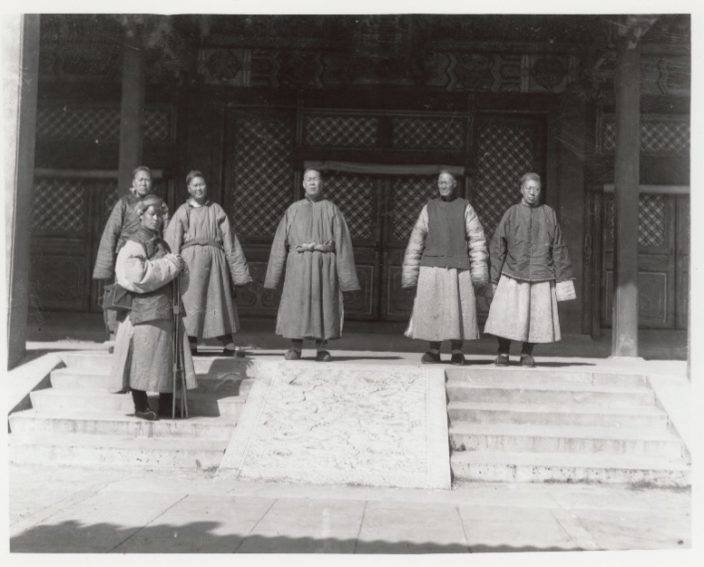
Eunuchs in the Grounds of the Forbidden City, ca. 1884 - 1924, Beijing, China. Gerow D. Brill papers, #1379. Division of Rare and Manuscript Collections, Cornell University Library.. RMC2016_0068.jpg.

Eunuchs were firsthand witnesses to the decline and fall of the Qing dynasty in 1911. As the emasculated servants of the emperor and his court, palace eunuchs provide an important lens for understanding the history of the imperial court and Chinese society as China transitioned from a monarchy to republic. During the reign of China’s last emperor, Aisin Gioro Puyi, and on into the early years of the republic, emperor-eunuch relations deteriorated. As both sides struggled to find purpose and survive in a world in which they were now irrelevant, eunuchs were accused of stealing palace treasures and artwork, opening antique shops near the palace to sell them, and even plotting to kill the former emperor.

Dr. Melissa S. Dale is an Associate Professor of History and former Executive Director of the Center for Asia Pacific Studies at the University of San Francisco. She specializes in late imperial Chinese history, specifically eunuchs and Qing dynasty court life.

Registration Policies

The Society for Asian Art’s cancellation policy requires at least one week’s advance written notice in order to receive a refund of registration fees. This excludes our Travel programs, which have separate cancellation policies, as well as any programs where a specific refund policy is stated on the event page. Your fees will be returned to you through a check in the mail. To cancel, please contact us.

For programs located within the Asian Art Museum, the museum entrance fee must be paid separately and is not included with your registration fee.

Please note that by registering for a program, you are giving consent to the SAA to be photographed or videoed as a participant.
More Programs

view all